July 29, 2026
New Research: Why Touch Typing Can Be a Game-Changer for Children with Dyslexia and Dyspraxia (DCD)
New Research: Why Touch Typing Can Be a Game-Changer for Children with Dyslexia and Dyspraxia (DCD)

For many children, handwriting is simply another classroom skill. But for children with dyslexia or Developmental Coordination Disorder (DCD/dyspraxia), handwriting can become a major barrier to learning.
Over the past few years, researchers have examined whether touch typing can help these children participate more successfully in school. While the evidence shows that typing is not an immediate replacement for handwriting, it highlights significant benefits when children receive structured touch-typing instruction.
What Does the Latest Research Say?
A major review published in 2024 by researchers at Oxford Brookes University examined studies on typing in children with developmental disorders, including dyslexia and DCD.
The review concluded that:
- Typing has become an essential educational skill.
- Children with dyslexia and DCD often experience greater difficulty learning to type than their peers.
- Simply giving a child a laptop is not enough—many require explicit touch typing instruction.
- Schools need better methods of assessing typing skills so children receive appropriate support.
The researchers also noted:
“Typing is often recommended as a useful accommodation for students with Developmental Coordination Disorder (DCD) and Specific Learning Disorder (SLD).”
New 2026 Study Highlights the Importance of Learning to Type Properly
A 2026 study comparing handwriting and keyboarding in primary school pupils with DCD found some interesting results.
Researchers discovered that:
- Children with DCD had significantly poorer handwriting than their classmates.
- Their keyboarding accuracy was similar to that of typically developing children.
- However, most children had never received systematic keyboarding instruction and therefore typed more slowly than they handwrote.
The authors concluded that children with DCD may benefit greatly from structured touch typing lessons, particularly those whose handwriting is difficult to read.
This is an important point.
Typing is a skill—just like handwriting. If children are expected to use computers in school without first learning efficient keyboarding, they may never experience the full benefits.
Dyslexia: Typing May Support Learning
Another recent study (2025) investigated how handwriting and typing affect learning new words.
Researchers found that children with dyslexia showed:
- Better spelling recall when learning through typing.
- Better understanding of word meaning after typing activities.
- Evidence that typing can reduce some of the challenges associated with spelling and orthographic processing.
While handwriting remains important for early literacy development, these findings suggest that touch typing can become a valuable support as children grow older and academic writing demands increase.
Why Touch Typing Helps
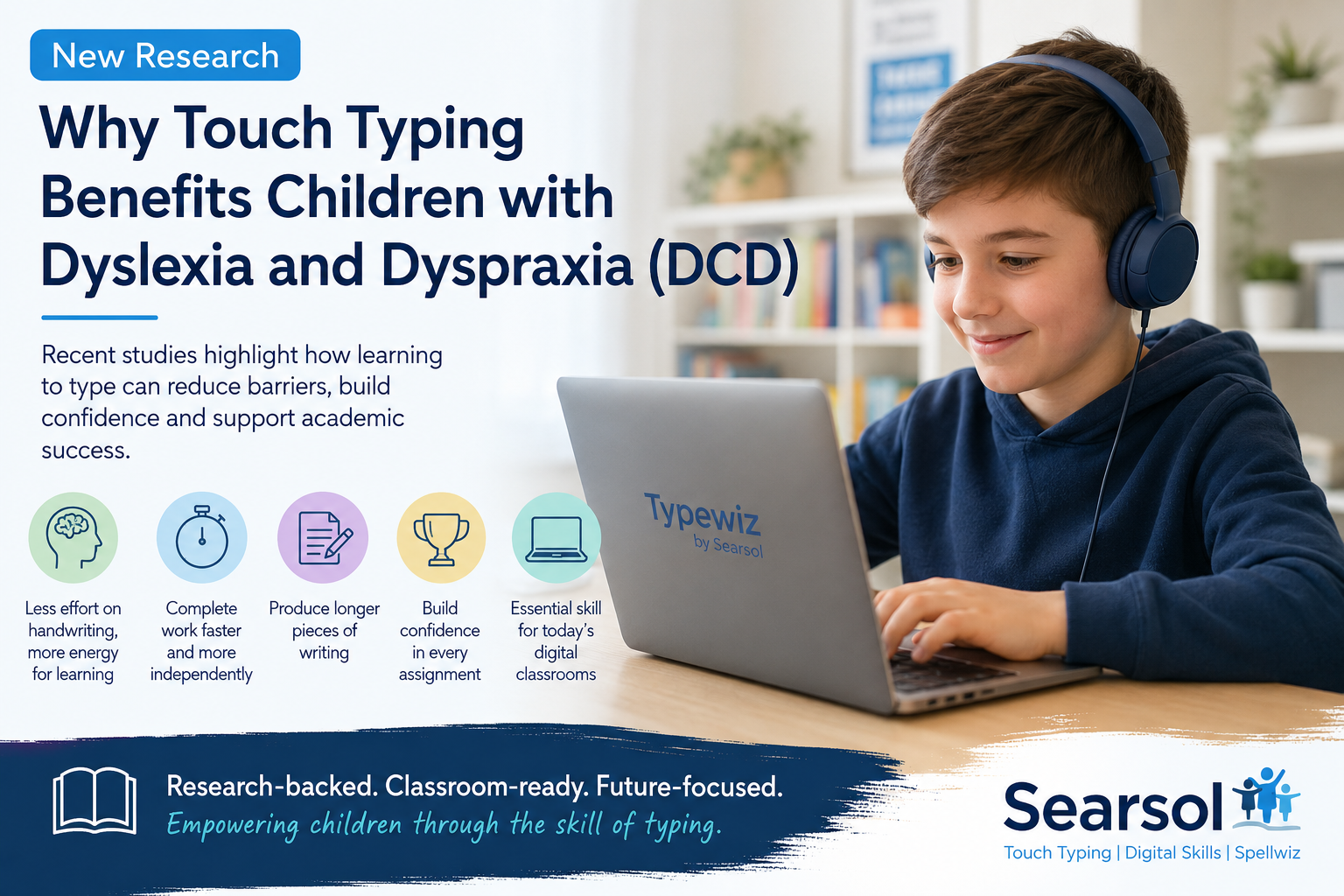
Children with dyslexia or dyspraxia often spend so much effort forming letters that less mental energy is available for thinking about ideas, spelling or organising their work.
Once touch typing becomes automatic, many children can:
- Complete homework more quickly.
- Produce longer pieces of writing.
- Spend less effort on handwriting.
- Edit work more easily.
- Build confidence in written assignments.
- Participate more independently in classroom activities.
The goal isn’t to replace handwriting—it is to give children another effective way to demonstrate what they know.
The Earlier Children Learn, the Better
Today’s classrooms increasingly rely on digital technology.
Secondary school students are expected to:
- Complete assignments digitally.
- Research online.
- Produce presentations.
- Sit computer-based assessments.
- Use laptops for everyday learning.
Learning touch typing in primary school gives children time to develop speed, accuracy and confidence before these demands become part of everyday education.
How Searsol Can Help
At Searsol, we’ve been teaching children to touch type since 2008.
Our structured after-school classes are specifically designed to support children with:
- Dyslexia
- Dyspraxia (DCD)
- Dysgraphia
- Autism
- ADHD
- Other learning differences
Using our engaging Typewiz programme, children learn correct finger placement, improve typing speed and accuracy, and develop a lifelong skill that supports learning both inside and outside the classroom.
We also offer a free trial assessment, allowing families to see whether our programme is the right fit before enrolling.
Final Thoughts
Recent research reinforces what many parents and teachers have observed for years: technology can be a powerful educational support—but only when children are taught how to use it effectively.
Touch typing is not simply about using a keyboard. It is about reducing barriers, increasing independence, and allowing children with dyslexia and dyspraxia to focus on what really matters: learning.
References
Barnett, A. L., & Stuart, N. (2024). Understanding Typing Skill in Students With Developmental Disorders. Current Developmental Disorders Reports, 11, 63–74.
Khoury-Shaheen, R., & Weintraub, N. (2026). Keyboarding and handwriting in school students with Developmental Coordination Disorder. Reading and Writing.
Learning by Writing: The Influence of Handwriting and Typing on Novel Word Learning in Typically Developing Readers and Readers with Dyslexia. Learning and Instruction (2025).