January 25, 2017
What Typing Speed Should My Child Aim For? Bronze, Silver and Gold Explained
“How fast should my child be typing?” It’s one of the questions we hear most at Searsol. Usually it comes from a parent watching their child hunt for letters with two fingers while homework drags on. The honest answer is that it depends on their age, practice and the work they need to do. Clear targets still help, so here’s a simple guide built around Irish school years, using Searsol’s Bronze, Silver and Gold levels.
See where your child is today with a free 1-hour trial class at your nearest centre: searsol.com/find-centers/.
Bronze: about 15 WPM
Your child knows the home keys and can type short pieces of schoolwork without looking down. For many children this is already as fast as their handwriting.
Silver: about 25 WPM
This is the level that’s suitable for the State exams, the Junior Cycle and the Leaving Cert. Homework and projects take less time, and children can spend more of their energy on what they want to say.
Gold: about 40 WPM
At Gold, your child types faster than they can write by hand. It’s a very hard standard that only about 5% of students achieve.
Accuracy matters just as much as speed. A child typing 20 WPM with very few mistakes is in a better place than one typing 30 WPM and correcting every second word.
A rough guide by class
Every child is different. Children with dyslexia, dyspraxia (DCD) or handwriting difficulties may take a little longer, but they often benefit the most. Think of these as rough, encouraging targets, not tests.
- 2nd and 3rd class (ages 7 to 9): getting to know the keyboard. We recommend starting proper touch typing from about age 8, when hands are big enough to rest on the home keys. Early on, good habits matter more than speed.
- 4th and 5th class (ages 9 to 11): working towards Bronze. Children who practise little and often can reach about 15 WPM, which for many is already as fast as their handwriting.
- 6th class (ages 11 to 12): working towards Silver. This is the ideal year to get there before secondary school, when typed homework, projects and laptops become part of everyday life.
- 1st to 3rd year (Junior Cycle): Silver. Typed Classroom-Based Assessments, projects and research all go faster when typing is automatic.
- 5th and 6th year (Leaving Cert): Silver, with Gold as a stretch goal. Project work is now worth at least 40% in many of the new Leaving Cert subjects, and some students can use a laptop in the State exams through the RACE scheme. Silver at about 25 WPM is the benchmark that’s suitable for the exams.
Why touch typing beats two-finger typing
Most children teach themselves to type by looking at the keys and using two or three fingers. That’s fine for a quick message, but it gets slow and tiring for longer work, and it tends to stop improving early.
Touch typing uses all ten fingers and muscle memory, so the eyes stay on the screen and speed keeps climbing with practice. The good news is that the two-finger habit can be broken at any age. It just takes structure and a bit of patience.
What the research says
In an Australian study, Carol Christensen gave 13-year-olds 20 minutes of touch typing practice a day for eight weeks. The quality of their writing improved compared with students who weren’t taught. In the United States, Michael Russell found that students who typed their essays wrote longer and more developed pieces than those who wrote by hand.
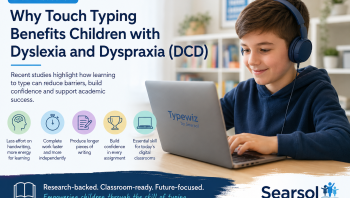
Especially helpful for dyslexia and dyspraxia (DCD)
For children who find handwriting hard, reaching Silver or Gold can turn homework from a struggle into something manageable.
How to check your child’s speed at home
Ask your child to copy a short paragraph from a book for one minute without looking at their hands. Count the words typed and take away any with mistakes. Do this every few weeks, and celebrate the progress, not the number.
Two things to watch:
- If your child keeps looking down, a keyboard cover can help.
- If they’re getting frustrated, slow down. Accuracy first, speed second, every time.
When it’s worth getting help
It may be time for a class if:
- homework takes much longer than it should
- handwriting is slow, messy or tiring
- your child has a laptop for school or exams but types with two fingers
- they’ve tried free games at home but lost interest after a week
If you’d like a sense of how long the journey usually takes, we also have a guide on how long it takes a child to learn to touch type.
How Searsol helps
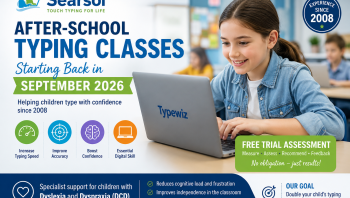
Since 2008, Searsol has been teaching children across Ireland to touch type. Our after-school classes are for children aged 8 and up, in small groups of up to 15, with an experienced tutor who watches posture and technique. Between classes, children keep practising at home on Typewiz, our typing programme with games, avatars and Bronze, Silver and Gold badges.
We run classes in Dublin (Lucan, Killester, Whitehall, Swords, Dundrum, Goatstown and Blanchardstown), in Naas, Co Kildare, and in Kells, Co Meath.
FAQ
What’s a good typing speed for a 10-year-old?
Around 15 WPM (our Bronze level), with good accuracy, is a great target.
What typing speed is needed for the Leaving Cert?
There’s no official speed. About 25 WPM (Silver) is suitable for the State exams, including the Junior Cycle and the Leaving Cert. Gold at about 40 WPM is a very hard standard that only about 5% of students achieve.
What age should my child start touch typing?
We recommend starting at about age 8.
Book a free 1-hour trial class
Book a free 1-hour trial class at your nearest Searsol centre. Your child will meet the tutor and try Typewiz, and you’ll get feedback on their typing before you decide anything. We’ll check your child’s current speed and show you how they can work up to Gold. Visit searsol.com/find-centers/ or call +353 1 630 3384.